
Numbers don't match Shopify
Why Luria's conversions, revenue and rates are lower than Shopify's, and how to compare them fairly.
Luria and Shopify are counting two different things, so the two numbers are not meant to match. Shopify counts every order your store takes. Luria counts the orders it can honestly claim.
What you'll need
- Your Shopify order list for a date range.
- The Luria dashboard at luriart.com/app.
- Your store's time zone.
Steps
Step 1: Compare attributed orders, not all orders
Luria counts an order only when it arrives carrying the attributes stamped on the cart by a tracked session. Phone orders, draft orders, orders from visitors on Global Privacy Control or Do Not Track, and orders from visitors who declined tracking all stay out. In Shopify they are ordinary orders.
Step 2: Subtract full refunds
Luria's tracked revenue drops by the amount refunded, and a fully refunded order gives back the free-allowance slot it used. Shopify's order count keeps the order.
Step 3: Line up the window
Luria's weekly chart uses rolling seven-day buckets ending now, and the visitor meter counts from the first of the month in UTC. Shopify reports in your store's time zone. A day at either edge of your range can move several orders across the boundary.
Step 4: Read the test numbers as test numbers
On the Split Tests tab, a session counts as a conversion for an arm only if the purchase happened at or after that session was first shown that arm. This keeps an old purchase from being credited to a test that started later, and it means the per-test totals are smaller than your store total.
Verify it worked
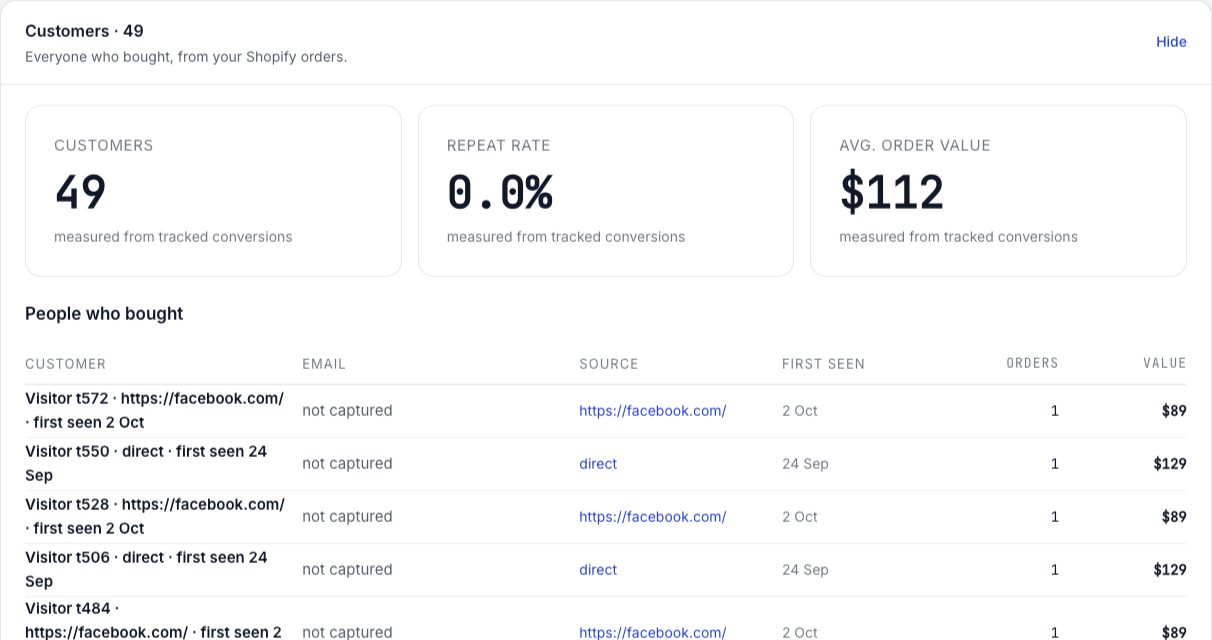
Pick one day, list the Shopify orders for it, and mark the ones placed by visitors who browsed your storefront normally. That subset is what Luria should be close to. The Customers section on the Overview tab lists converted sessions one row per conversion, so you can check them off individually.
Common failures
- Comparing conversion rates. Luria's conversion rate is measured on tracked traffic, which is the traffic it actually saw. Shopify's is measured on its own session count, which includes traffic Luria never tracked.
- Reading lift as store-wide. Lift compares against your four-week baseline and is labeled "estimate" until that baseline is frozen. It is not a claim about total store revenue.
- Bots and scripted checks. Requests from headless and crawler user agents are filtered out of Luria's numbers, and Shopify's analytics filter differently.
- Consent regions. In the EU, the UK and Switzerland nothing is tracked before the visitor accepts, so those buyers can convert in Shopify while being invisible to Luria.